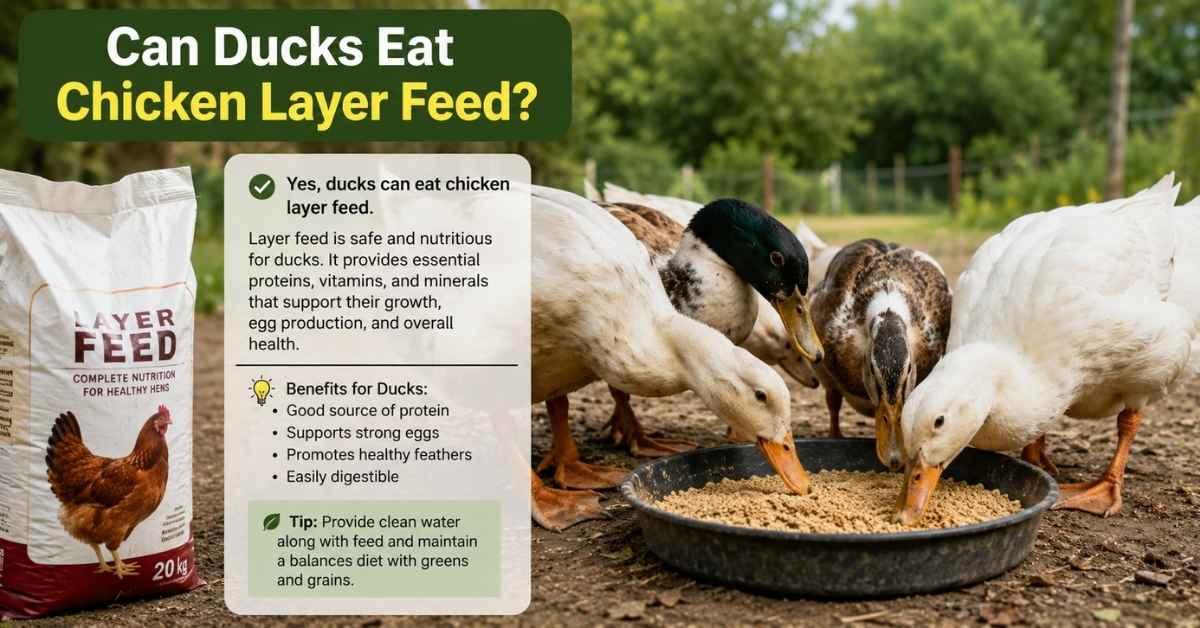
Can ducks eat chicken layer feed? Yes, adult ducks can eat chicken layer feed occasionally, but it is not the best long-term diet for most ducks. Chicken layer feed is formulated for laying hens and contains higher levels of calcium than many ducks need. It may also lack sufficient niacin, an important nutrient for healthy duck growth and development. While an occasional meal is unlikely to cause harm, duck owners should understand the nutritional differences before making chicken layer feed a regular part of a duck’s diet.
If you keep a mixed flock or accidentally bought the wrong feed, you’re not alone. Many backyard poultry keepers wonder whether ducks and chickens can eat the same feed. The answer depends on the duck’s age, life stage, and overall nutritional needs.
Understanding the differences between duck feed, chicken feed, all-flock feed, and layer pellets can help you avoid nutritional deficiencies and create a healthier feeding program for your birds. This guide explains everything you need to know about feeding ducks chicken layer feed, including potential risks, feeding recommendations, and the best options for mixed flocks.
Quick Answer
Here is the short version:
| Duck Type | Can Eat Chicken Layer Feed? | Recommendation |
|---|---|---|
| Ducklings | No | Choose waterfowl or all-flock feed with added niacin |
| Growing Ducks | Limited | Use only temporarily |
| Adult Drakes | Occasionally | Not ideal long-term |
| Adult Non-Laying Ducks | Occasionally | Better alternatives exist |
| Laying Ducks | Yes, in moderation | Can be used but may not be optimal |
For most duck keepers, all-flock feed supplemented with free-choice calcium is often a better solution than feeding chicken layer feed to every bird in the flock.
Chicken Layer Feed and Duck Feed Are Not Formulated for the Same Bird
Many people assume ducks and chickens have identical dietary requirements because both are poultry. In reality, ducks are waterfowl, and their nutritional needs differ from those of chickens in several important ways.
Why Ducks Have Different Nutritional Needs Than Chickens
Ducks grow faster than many chicken breeds and require different nutrient balances during key stages of development. One of the most important differences involves niacin (Vitamin B3).
Young ducks require significantly more niacin than young chickens. This nutrient supports healthy bone formation, proper leg development, nerve function, and overall growth. A deficiency can lead to mobility problems, weak legs, and poor growth rates.
Ducks also process minerals differently. While laying hens benefit from elevated calcium levels for eggshell production, excessive calcium can be unnecessary for many ducks, particularly drakes and non-laying birds.
These differences explain why experienced poultry keepers often recommend species-specific feeding plans instead of assuming one feed works perfectly for every bird.
What Chicken Layer Feed Is Designed to Do
Chicken layer feed is specifically formulated to support egg-laying hens.
Its primary purpose is to:
- Promote strong eggshell production
- Provide adequate protein for laying hens
- Deliver elevated calcium levels
- Support consistent egg production
Most layer feeds contain considerably more calcium than grower or all-flock feeds because hens require large amounts of calcium to produce eggs regularly.
For chickens, this formulation makes sense. For ducks, however, the situation is more complex.
What Ducks Need From Their Daily Diet
A balanced duck diet should include:
- Appropriate protein levels
- Adequate niacin
- Essential amino acids
- Vitamins and minerals
- Consistent access to clean water
- Proper energy sources
The ideal feed depends on whether the bird is a duckling, growing duck, laying duck, breeding duck, or drake.
Because ducks often consume food differently than chickens and rely heavily on water during feeding, nutritional balance becomes even more important.
Can Ducks Eat Chicken Layer Feed Based on Their Age and Life Stage?
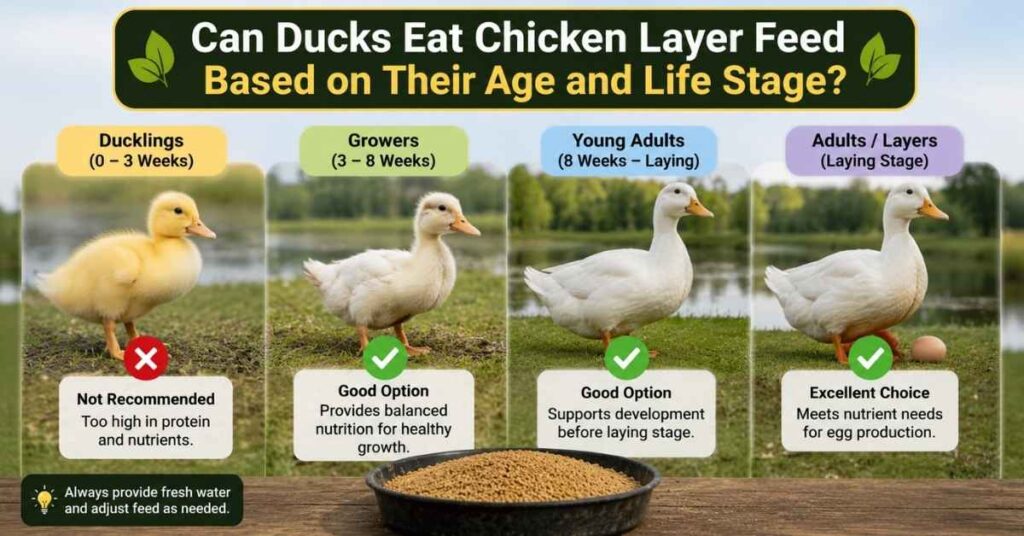
Not all ducks have the same nutritional requirements. A duckling and a mature laying duck need very different diets.
Ducklings
Ducklings should generally not be fed chicken layer feed as their primary diet.
The biggest concern is that layer feed often lacks sufficient niacin while containing more calcium than young ducks require. During the first weeks of life, ducklings undergo rapid skeletal growth and depend on proper nutrient ratios to develop strong legs and joints.
Common signs of nutritional problems in ducklings include:
- Difficulty walking
- Bowed legs
- Slow growth
- Reduced activity
- Poor feather development
A waterfowl starter feed or an all-flock feed supplemented with brewer’s yeast is usually a better option.
Growing Ducks
Growing ducks need balanced nutrition that supports continued development without excessive calcium intake.
If chicken layer feed is used temporarily because of a feed shortage, it usually won’t create immediate problems. However, relying on it for months may not provide the ideal nutritional profile for healthy growth.
Many experienced duck keepers prefer:
- Waterfowl grower feed
- All-flock feed
- Non-medicated poultry grower feed with niacin supplementation
These options generally offer a more appropriate balance for developing ducks.
Adult Non-Laying Ducks
Adult non-laying ducks can eat chicken layer feed, but it may not be the best long-term choice.
This category includes:
- Pet ducks
- Retired laying ducks
- Seasonal non-layers
- Drakes
Since these birds are not producing eggs regularly, they do not require the same high calcium levels found in layer pellets.
Over time, feeding excessive calcium may create nutritional imbalances that serve no practical benefit.
Adult Drakes
Drakes are often overlooked in feeding discussions.
Many articles focus entirely on laying birds while ignoring male ducks.
Because drakes never produce eggs, they generally have lower calcium requirements than laying hens or laying ducks. Feeding high-calcium chicken layer feed indefinitely may not be the most suitable strategy.
For mixed flocks, many poultry nutritionists recommend an all-flock feed combined with separate oyster shell supplementation for birds that need extra calcium.
Laying Ducks
Laying ducks are the group most likely to tolerate chicken layer feed successfully.
These birds require additional calcium for egg production and can benefit from higher mineral levels during laying periods.
However, even laying ducks may benefit from feeds formulated specifically for waterfowl because they provide nutrient balances tailored to duck physiology rather than chicken physiology.
The goal should always be long-term nutritional balance rather than simply providing extra calcium.
What Happens If Ducks Eat Chicken Layer Feed?
One of the most common concerns among backyard poultry owners is whether ducks will become sick after eating chicken layer feed. In most cases, the answer depends on how much they ate, how often they eat it, and their age.
A duck that steals a few mouthfuls from the chicken feeder is usually not in danger. Problems are more likely to occur when layer feed becomes the bird’s primary diet for extended periods.
If Ducks Eat Chicken Layer Feed Once
If your ducks accidentally eat chicken layer pellets once or twice, there is usually no reason to panic.
Most healthy adult ducks can tolerate occasional access to layer feed without showing any adverse effects. Their digestive system can process the feed, and a single feeding is unlikely to create nutritional imbalances.
In fact, many mixed-flock owners discover their ducks occasionally eating chicken feed despite separate feeding arrangements.
Monitor your birds as normal and provide access to fresh water and their regular feed.
If Ducks Eat Layer Feed for Several Days
A short-term feeding situation is typically manageable.
This often happens when:
- Duck feed runs out unexpectedly
- A feed delivery is delayed
- The local feed store has limited inventory
- A flock owner purchases the wrong feed by mistake
Using layer feed for several days generally does not create major issues for healthy adult ducks. However, it should be viewed as a temporary solution rather than a permanent feeding strategy.
During this period, observe:
- Appetite
- Activity levels
- Feather condition
- Water consumption
- Egg production
If Ducks Eat Layer Feed for Months
Long-term feeding is where concerns become more significant.
Over months, ducks may receive:
- Excess calcium
- Insufficient niacin
- Nutritional ratios designed for chickens rather than waterfowl
The result may not be immediately obvious. Many dietary imbalances develop gradually.
Potential concerns include:
- Reduced growth in young birds
- Nutrient deficiencies
- Lower overall performance
- Inefficient nutrient utilization
This is why most experienced duck keepers recommend transitioning to a more suitable feed whenever possible.
Warning Signs Your Duck’s Diet Needs Adjustment
A duck’s appearance and behavior often reveal whether its nutritional needs are being met.
Watch for:
- Poor feather quality
- Weak legs
- Slower growth
- Decreased activity
- Reduced egg production
- Weight loss
- Difficulty walking
- Dull plumage
While these signs can have multiple causes, nutrition should always be considered when evaluating flock health.
The Biggest Nutritional Concerns Duck Owners Overlook
Many online articles simply state that ducks can eat chicken feed and stop there. The real issue isn’t whether ducks can eat it—it’s whether the feed meets the bird’s nutritional requirements over time.
Why Niacin Matters More for Ducks Than Chickens
Niacin (Vitamin B3) is one of the most important nutrients for growing ducks.
Compared with chickens, ducks require significantly higher levels of niacin for proper development.
Niacin supports:
- Bone growth
- Joint health
- Nervous system function
- Muscle development
- Mobility
A deficiency can lead to serious developmental problems, particularly in ducklings.
Common signs of niacin deficiency include:
- Bowed legs
- Weak legs
- Difficulty standing
- Reluctance to walk
- Poor growth rates
Because many chicken feeds are formulated for chickens rather than ducks, niacin intake becomes an important consideration whenever ducks consume chicken feed regularly.
Can Too Much Calcium Become a Problem?
Chicken layer feed contains elevated calcium levels because laying hens require large amounts of calcium to produce eggshells consistently.
For laying birds, this is beneficial.
For non-laying ducks and drakes, excessive calcium offers little advantage.
Over time, unnecessary calcium intake may place additional stress on the body’s mineral-balancing systems. While healthy adult ducks often tolerate occasional exposure without issues, long-term feeding is generally not considered ideal.
This is one reason many mixed-flock keepers choose an alternative feeding strategy rather than feeding layer feed to every bird.
Protein Levels and Growth Performance
Protein is another key consideration.
Growing ducks need sufficient protein to support:
- Muscle development
- Feather growth
- Organ development
- Healthy body condition
The protein level in layer feed may not always align with the needs of rapidly growing ducks.
A feed designed specifically for waterfowl or growing poultry often provides a more suitable balance.
LEARN MORE: Can Ducks Eat Carrots and Celery?
Ducks and Chickens Living Together: The Real Question Most Owners Are Asking
Many people searching “can ducks eat chicken layer feed” are actually asking a different question:
Can ducks and chickens share the same feed?
This is one of the biggest challenges facing backyard flock owners.
Can Ducks and Chickens Share the Same Feed?
Technically, yes.
Practically, it depends on your management system.
When ducks and chickens share a coop or free-range area, preventing feed sharing can be difficult.
Many flock owners successfully manage mixed flocks by using feeding programs that meet the needs of both species rather than relying solely on layer feed.
The Best Feeding System for Mixed Flocks
One of the most effective systems involves:
- Feeding an all-flock feed to the entire flock
- Offering separate oyster shell for laying birds
- Monitoring body condition and egg production
- Adjusting supplements as needed
This approach allows:
- Chickens
- Ducks
- Drakes
- Young birds
to consume a balanced feed while laying birds access additional calcium when necessary.
Why Many Experienced Keepers Choose All-Flock Feed
All-flock feed has become increasingly popular among homesteaders and backyard poultry enthusiasts.
Benefits include:
- Suitable for multiple poultry species
- Lower calcium than layer feed
- Better flexibility
- Easier flock management
- Reduced risk of overfeeding calcium
For many mixed flocks, this represents the most practical compromise.
Mixed Flock Feeding Example
Imagine a flock consisting of:
- 6 laying hens
- 3 laying ducks
- 2 drakes
Instead of feeding layer pellets to every bird, the owner provides:
- All-flock feed as the base ration
- Oyster shell in a separate container
- Free-choice access for laying birds
This system often delivers better nutritional balance across the entire flock.
Emergency Situations Every Duck Owner Encounters
I Ran Out of Duck Feed — What Can I Feed Today?
This is one of the most common emergency feeding scenarios.
If duck feed is temporarily unavailable, options may include:
- All-flock feed
- Poultry grower feed
- Chicken layer feed (temporary use)
- Waterfowl feed from another brand
The key is viewing these solutions as temporary while obtaining a more suitable feed.
I Accidentally Bought Chicken Layer Feed
Don’t panic.
Many new duck owners make this mistake.
If you purchased chicken layer feed:
- Use it temporarily if necessary
- Transition gradually to a better option
- Monitor duck health
- Avoid feeding it exclusively to ducklings
My Ducks Keep Eating the Chickens’ Feed
This is extremely common.
Ducks are opportunistic feeders and rarely respect species-specific feeding plans.
Possible solutions include:
- Separate feeding stations
- Elevated chicken feeders
- Timed feeding schedules
- Supervised feeding periods
Perfect separation isn’t always realistic, especially in free-range systems.
My Feed Store Doesn’t Sell Duck Feed
Many rural areas have limited feed options.
In these situations, look for:
- All-flock feed
- Flock raiser feed
- Non-medicated grower feed
- Poultry feeds with appropriate nutrient profiles
Reading feed labels becomes especially important when species-specific feeds are unavailable.
How to Choose the Best Feed for Ducks
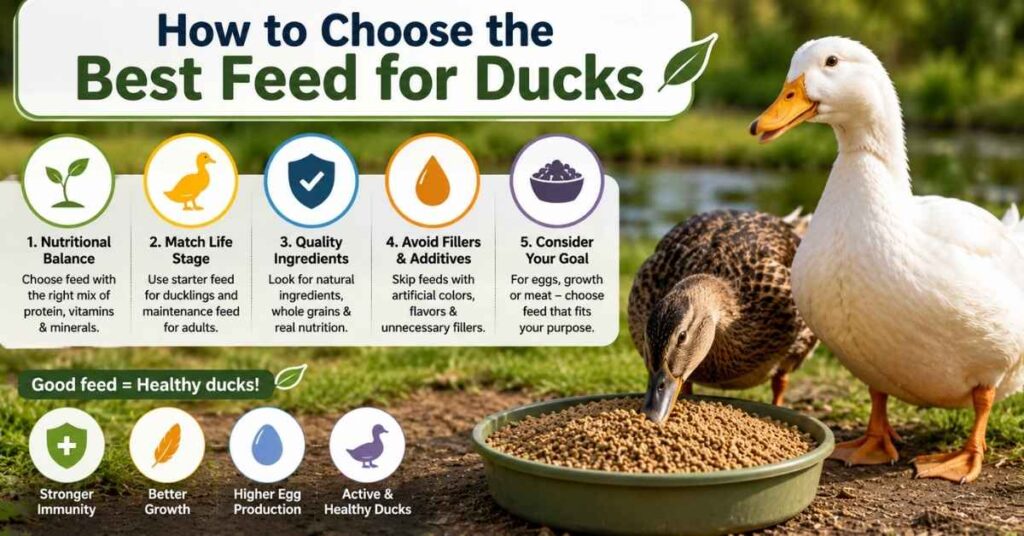
Choosing the right feed becomes much easier when you understand what to look for on a feed label. Rather than focusing only on brand names, experienced poultry keepers evaluate the nutrient profile and whether it matches the bird’s life stage.
Reading a Feed Label Like an Experienced Duck Keeper
When comparing feeds, pay attention to:
- Protein percentage
- Calcium levels
- Vitamin supplementation
- Niacin content
- Ingredient quality
- Life-stage recommendations
A feed that works perfectly for laying hens may not be the best option for ducklings, drakes, or non-laying ducks.
Always choose a feed based on the bird’s nutritional needs rather than simply purchasing whatever poultry feed is available.
Duck Feed vs Layer Feed vs All-Flock Feed
The table below highlights the major differences.
| Feature | Duck Feed | Chicken Layer Feed | All-Flock Feed |
|---|---|---|---|
| Formulated for Ducks | Yes | No | Partially |
| Suitable for Ducklings | Yes | No | Often Yes |
| Higher Niacin Levels | Usually | Usually Lower | Moderate |
| High Calcium Content | Moderate | High | Lower |
| Suitable for Mixed Flocks | Good | Limited | Excellent |
| Best Long-Term Choice for Ducks | Yes | Usually No | Often Yes |
| Suitable for Drakes | Yes | Not Ideal | Yes |
For most mixed-flock situations, all-flock feed combined with separate calcium supplementation provides one of the most practical feeding solutions.
Ingredients Worth Looking For
Quality feeds often contain:
- Balanced protein sources
- Essential amino acids
- Vitamin supplementation
- Mineral support
- Whole grains
- Consistent nutrient profiles
These ingredients help support:
- Healthy growth
- Strong feathers
- Egg production
- Immune function
- Overall flock health
Ingredients That Deserve Extra Attention
Some feeds contain excessive fillers or nutrient ratios designed for specific poultry species.
Pay close attention to:
- Excess calcium
- Poor-quality fillers
- Incomplete vitamin profiles
- Feeds not intended for waterfowl
A few minutes spent reading labels can prevent months of nutritional issues.
Common Feeding Mistakes New Duck Owners Make
Many feeding problems occur because owners assume ducks and chickens have identical requirements.
Assuming Ducks and Chickens Need the Same Nutrition
This is perhaps the most common mistake.
While ducks and chickens share many dietary similarities, ducks have unique nutritional requirements that should not be ignored.
Feeding Layer Feed to Every Bird in the Flock
Layer feed was developed for laying birds.
When drakes, ducklings, and non-laying ducks consume large amounts over extended periods, the nutritional balance may no longer be ideal.
Ignoring Niacin During Growth
Many new owners learn about niacin only after seeing leg problems develop in ducklings.
Providing adequate niacin during early growth is one of the most important aspects of duck nutrition.
Switching Feeds Too Frequently
Constant dietary changes can create unnecessary stress.
Whenever possible:
- Transition gradually
- Mix feeds during changes
- Monitor bird condition
- Avoid abrupt feed switches
Relying Too Heavily on Treats
Treats can be enjoyable additions to a duck’s diet, but they should never replace a balanced feed.
Excessive treats may dilute nutrient intake and reduce feed quality.
LEARN MORE: Can Ducks Eat Carrots Raw or Cooked?
Real-Life Feeding Scenarios
Understanding how experienced flock owners manage real situations can make feeding decisions much easier.
Scenario 1: Backyard Family Flock
A family keeps:
- 8 laying hens
- 4 laying ducks
Instead of feeding separate rations, they provide:
- All-flock feed
- Oyster shell in a separate dish
- Fresh water at all times
This system reduces complexity while meeting the needs of both species.
Scenario 2: Raising Ducklings With Chicks
A homesteader raises ducklings and chicks together.
Because ducklings require more niacin, the owner chooses:
- All-flock starter feed
- Brewer’s yeast supplementation
- Separate monitoring during growth
This approach helps prevent common developmental issues.
Scenario 3: Small Homestead With Limited Feed Options
In rural areas, duck-specific feed may not be available.
The owner selects:
- Flock raiser feed
- Supplemental nutrients if needed
- Careful label evaluation
This strategy often works better than relying exclusively on chicken layer feed.
Scenario 4: Free-Range Ducks
Free-ranging ducks obtain part of their nutrition from:
- Insects
- Grasses
- Aquatic plants
- Natural forage
Even so, a balanced feed remains important for ensuring nutritional consistency throughout the year.
Signs Your Current Feeding Program Is Working
A healthy duck usually tells you a lot through its appearance and behavior.
Healthy Growth Indicators
Growing ducks should demonstrate:
- Steady weight gain
- Strong legs
- Proper posture
- Consistent development
Feather Quality
Healthy feathers are often:
- Smooth
- Dense
- Clean
- Well-maintained
Poor feather condition may indicate nutritional imbalances.
Activity Levels
Healthy ducks are generally:
- Alert
- Curious
- Active
- Social
A sudden change in behavior deserves attention.
Egg Production Quality
For laying ducks, monitor:
- Egg size
- Shell quality
- Production consistency
Changes may indicate dietary adjustments are needed.
Body Condition
A well-fed duck should maintain:
- Good muscle tone
- Healthy body weight
- Strong mobility
- Consistent energy levels
Frequently Asked Questions
Can ducks eat chicken layer pellets every day?
Adult ducks can eat chicken layer pellets, but they are usually not the ideal long-term feed. A duck-specific or all-flock feed often provides a more appropriate nutritional balance.
Can ducklings eat chicken layer feed?
Ducklings should generally avoid chicken layer feed because it may not provide adequate niacin and contains more calcium than young ducks require.
What happens if ducks eat too much calcium?
Long-term consumption of excessive calcium may create nutritional imbalances, particularly in drakes and non-laying ducks.
Can drakes eat layer feed?
Drakes can eat layer feed occasionally, but they do not require the elevated calcium levels formulated for laying birds.
Is all-flock feed better than layer feed for ducks?
For many mixed flocks, yes. All-flock feed provides a more balanced solution and allows calcium to be offered separately.
Do ducks need niacin supplements?
Ducklings often benefit from additional niacin, particularly when consuming feeds designed primarily for chickens.
Can ducks and chickens use the same feeder?
They can, but feed management becomes more difficult. Separate feeding systems often provide better nutritional control.
Is chicken grower feed better than layer feed for ducks?
In many situations, grower feed is closer to the nutritional needs of growing ducks than layer feed.
How long can ducks safely eat chicken layer feed?
Healthy adult ducks usually tolerate short-term feeding without issues. Long-term feeding should be evaluated carefully.
What is the best feed for ducks and chickens living together?
Many experienced poultry keepers recommend all-flock feed supplemented with separate oyster shell for laying birds.
Can ducks survive on chicken feed?
Ducks can survive on certain chicken feeds, but survival and optimal nutrition are not the same thing. A diet designed around duck nutritional requirements is generally preferable.
Can ducks eat chicken crumble?
Yes, ducks can eat chicken crumble, but the suitability depends on the formulation and life stage of the duck.
Conclusion
Can ducks eat chicken layer feed? Yes, adult ducks can eat chicken layer feed occasionally, and short-term feeding is generally safe for healthy birds. However, chicken layer feed was formulated for laying hens, not ducks, which means it may provide excessive calcium while failing to fully address important duck nutritional needs such as niacin.
For ducklings, chicken layer feed is generally not recommended. The For drakes and non-laying ducks, long-term feeding may not be ideal because of the higher calcium content. For laying ducks, layer feed can be used, but duck-specific feed or a properly managed all-flock feeding program is often a better long-term solution.
If you keep a mixed flock of ducks and chickens, many experienced poultry keepers find that all-flock feed plus separate oyster shell supplementation offers the best balance of convenience, nutrition, and flock health.
Ultimately, the best feed for ducks is one that supports their unique nutritional requirements, promotes healthy growth, maintains strong feather condition, supports egg production when needed, and provides a complete diet throughout every stage of life.